
A shoe company rebrands as an AI infrastructure play and jumps 600% in a day. A car rental business, drowning in debt, rockets from $100 to over $800 in a matter of weeks before giving half of it back in a single session. Every few weeks, a new stock story hijacks the financial news cycle, and this month brought us two.
Stories like these tend to pull investors in two directions. Some see them as a reason to participate more aggressively, assuming the market is rewarding bold ideas and they should be positioning for the next one. Others see them as a warning sign and start thinking about how to get defensive. I’d argue that both reactions are focused on the wrong question.
The more important thing to understand is what’s actually driving these moves. In my view, this is a market being shaped more by liquidity than by fundamentals, and the right response isn’t to chase it or retreat from it. It’s to stay anchored to a plan that was built with this kind of environment in mind.
A Closer Look at the Headlines
In mid-April, Allbirds (yes, the sustainable shoe company) announced it was pivoting to “AI compute infrastructure” under a new name, NewBird AI. The stock jumped nearly 600% the next day.
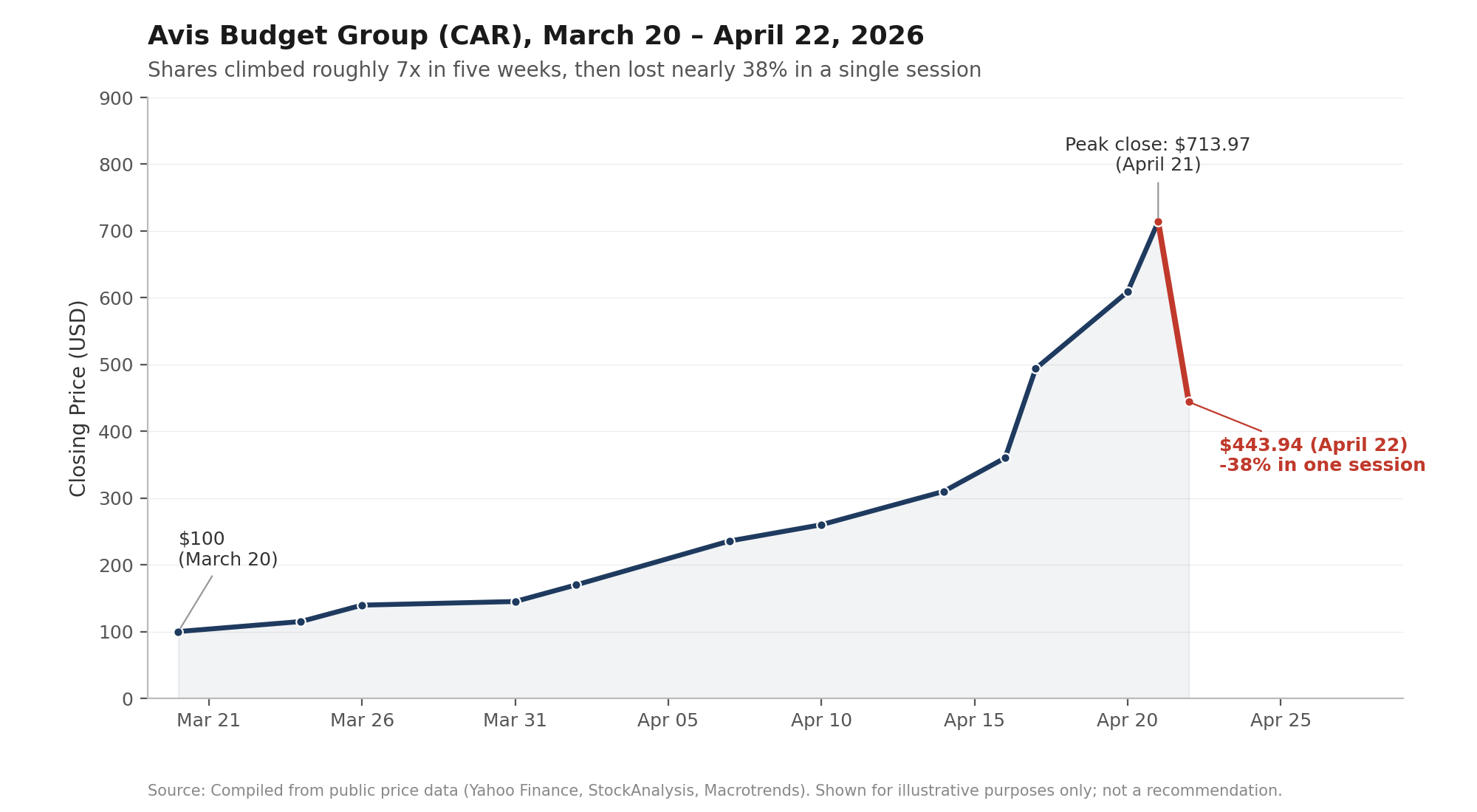
Avis Budget Group has been telling a different version of the same story, climbing from around $100 in late March to an intraday high above $800 last week on a short squeeze before snapping back violently, at valuations that look nothing like the underlying business.
When Liquidity Sets the Price
It’s worth asking why this environment exists, and why these moves happen more often than they used to. A large part of the answer is liquidity, which is just a fancy word for how much money is sloshing around the system looking for somewhere to go. Years of low interest rates, pandemic-era stimulus, and a steady rise in household savings have left trillions of additional dollars in the hands of investors, institutions, and ordinary people who, a decade ago, might never have opened a brokerage account. When there is that much capital looking for a home, it keeps searching for new stories and new returns.
This dynamic matters more than investors often realize. For decades, the standard way to think about what a stock was worth was to estimate the cash flows of the underlying business. You looked at earnings, revenue growth, debt, and competitive position, and arrived at a reasonable estimate of what a company was worth. That framework still applies, but in a liquidity-driven market, prices are increasingly being set by flows of money rather than by those traditional yardsticks.
The recent examples illustrate this clearly. Allbirds had essentially no operating business when its stock jumped 600%; there was no earnings report, no new product, and no change in fundamentals. Avis at its peak was trading at roughly 40 times its own historical average valuation while carrying $25 billion in debt. Neither of those prices can be explained by valuation. They can only be explained by the amount of money available to chase a story and the mechanics of where that money decided to go.
This pattern is not new. In 2017, a small beverage company called Long Island Iced Tea rebranded as “Long Blockchain” during the crypto mania, briefly tripled in value, and was eventually delisted. Different story, same underlying dynamic.
This does not mean valuation no longer matters. It always matters eventually. It means that in the short and even medium term, the weight of money moving around can push prices to places fundamentals would never support, and keep them there longer than feels reasonable.
What Discipline Actually Looks Like
None of this is a reason to panic, and it is not a reason to chase. But it is a reason to revisit how you are actually positioned. For clients I work with, that starts with a simple reframe. A disciplined portfolio is not one that ignores what is happening in the world. It is one that has already decided, in advance and in calmer conditions, how it will respond to new information. That framework includes a few things worth revisiting.
- Know what each dollar is for. Money earmarked for retirement income in 2045 should not be in conversation with money you might use for a home purchase in 2027. When everything is lumped together, every headline feels like it requires action.
- Separate “interesting” from “investable.” Some stories in the news are genuinely interesting, but that does not make them appropriate for a portfolio built to fund the next three decades of your life. If you want exposure to a speculative idea, the conversation is how much, not whether to reshape the whole portfolio around it.
- Keep a watchlist, not a wishlist. Write down the names you are interested in and track them for six months. If the thesis still makes sense when the headline has faded, that tells you something. If it does not, that also tells you something.
None of these are complicated. They are just easier to follow when you have decided on them in advance.
The Bigger Picture
It is easy to look at times like this and feel like the rules have changed. A shoe company becomes an AI company overnight. A struggling rental business becomes one of the best-performing stocks of the year. The pace of it can make a patient, diversified portfolio feel almost quaint by comparison.
But step back, and the bigger picture looks a lot like it always has. The investors who build real, lasting wealth are almost never the ones you read about. They are holding diversified portfolios through years of noise, letting compounding do the work, and resisting the urge to confuse motion with progress. The Allbirds and Avis stories will be forgotten by summer, and the liquidity fueling them will eventually rotate somewhere else. The discipline, or the lack of it, that investors apply during times like this will still be showing up in their account statements ten years from now.
If the current environment has you feeling like you are missing something, that is usually a sign it is time to revisit the plan. Not to chase, and not to retreat, but to sit down and talk through whether your portfolio still reflects what you actually want your money to do. That conversation is always open, and it is almost always more valuable than whatever the market is doing that week.