
Escalating conflict involving Iran has pushed oil prices sharply higher and injected a new dose of uncertainty into global markets. Oil recently surged over $100 per barrel as investors worried about potential disruptions to Middle Eastern supply routes, particularly through the Strait of Hormuz.
When oil prices spike during geopolitical conflicts, investors often assume inflation will follow. Higher gasoline prices, rising transportation costs, and more expensive industrial inputs can ripple quickly through the economy.
But the macro backdrop today is unusual.
The U.S. economy was already showing signs of weakening labor demand before the conflict escalated. At the same time, companies across the technology sector are increasingly using artificial intelligence to reduce white-collar staffing needs.
One recent example came from Block, which announced plans to reduce its workforce by roughly 40% as automation and AI tools increasingly replace roles that were previously handled by large corporate teams.
Taken together, these trends raise an important question for investors:
Could the same forces slowing the labor market ultimately offset the inflationary effects of higher oil prices?
Macro Insight
Geopolitical conflicts rarely impact markets directly. Instead, they influence markets primarily through energy prices.
When oil prices rise sharply, the effects typically include:
- higher gasoline and transportation costs
- increased manufacturing expenses
- upward pressure on consumer prices
- reduced disposable income for households
Economists estimate that a sustained $10 increase in oil prices can add roughly 0.2 percentage points to U.S. inflation.
But oil shocks rarely occur in isolation. Their ultimate impact depends on the underlying strength of the economy at the time they occur.
If economic demand is strong, higher energy prices can reinforce inflation. If demand is weakening, higher energy costs can accelerate a slowdown in economic activity.
Investment Lens
One of the most important signals investors watch is the health of the labor market.
When hiring is strong and wages are rising rapidly, inflation tends to persist because consumer demand remains strong.
But when labor demand weakens, wage growth slows and inflation often fades with it.
This slowdown is now reinforced by a structural shift that is just beginning to unfold: the rapid adoption of artificial intelligence across white-collar industries.
Companies are discovering that tasks previously handled by analysts, marketing teams, legal staff, and customer support departments can increasingly be automated or augmented by AI systems.
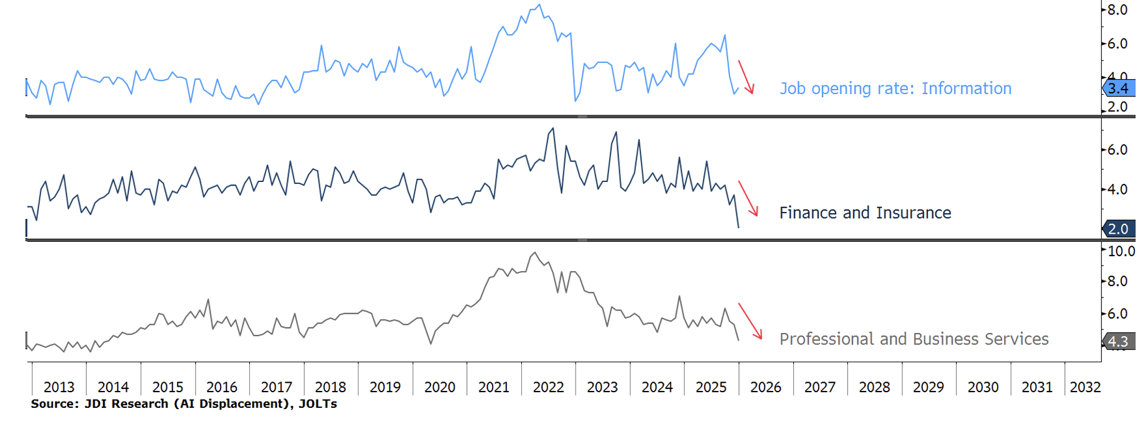
While technological innovation ultimately creates new industries and jobs over time, the transition period often reduces hiring demand in sectors undergoing rapid change.
For the broader economy, this matters because labor demand is one of the primary drivers of consumer spending.
If hiring slows across corporate America, household income growth tends to slow as well, reducing the demand that fuels inflation.
Why This Matters for Investors
For everyday investors, geopolitical headlines can make markets feel unpredictable.
But from an investment perspective, the key question is always the same:
How do these forces influence the direction of markets and portfolios?
Right now, three major macro forces appear to be interacting at the same time.
1. Energy Market Volatility
The Iran conflict has introduced a new risk premium into oil markets. If supply disruptions become severe or prolonged, inflation risks could rise.
But historically, many geopolitical oil spikes have reversed once supply fears ease.
2. A Softening U.S. Labor Market
Hiring demand was already cooling before the conflict began. A weaker labor market tends to reduce wage growth and consumer spending, which can slow inflation over time.
3. Structural Changes From Artificial Intelligence
AI adoption across corporate America may be accelerating this labor market shift by reducing hiring demand in white-collar sectors.
This does not necessarily reduce economic productivity. In fact, AI could boost productivity significantly.
But the transition may temporarily suppress hiring growth and slow economic momentum.
For investors, this combination of forces can produce short bursts of market volatility as markets attempt to price these competing trends.
Periods like this highlight why portfolio construction matters.
Rather than trying to predict geopolitical outcomes, the focus at Roundtable is on building portfolios that can adapt to changing economic environments.
Currently, several themes are shaping our investment positioning:
1. Inflation vs. Disinflation Uncertainty
Energy shocks can temporarily push inflation higher, but weakening labor demand could ultimately bring inflation back down. This uncertainty makes diversification across asset classes particularly important.
2. Structural Technological Change
Artificial intelligence is likely to reshape many industries in the years ahead. We believe the largest investment opportunities may not necessarily come from AI applications themselves, but from the companies that most effectively leverage the technology.
3. Market Volatility as Opportunity
Geopolitical events often create short-term market volatility that can present opportunities for disciplined investment strategies.
Rather than reacting emotionally to headlines, we use discretionary and systematic investment approaches that adjust exposure as market conditions evolve.
The Bigger Picture
Markets often react dramatically to geopolitical events.
But the long-term investment implications usually depend on how those events interact with broader economic trends.
Today, those trends include:
- energy supply risks
- a slowing labor market
- structural shifts in employment driven by artificial intelligence
These forces can pull the economy in different directions.
Higher oil prices may temporarily push inflation higher.
But weakening labor demand, particularly in white-collar sectors, could just as quickly reverse that pressure.
For investors, the lesson is simple:
The biggest risks to portfolios rarely come from the first shock. They come from how the economy responds afterward.
And right now, that response may already be underway.