
How life is being financialized like never before.
For most of modern history, financial markets have had clear edges. You could buy a stock, a bond, a house, or a commodity. Everything else (the outcome of an election, the price of a company before it went public, the result of a Sunday football game) sat outside the market.
Those edges have begun to dissolve, and the pace is accelerating. Almost everything is becoming something you can trade, price, and hold in a portfolio, and I think it is worth pausing to understand why that is happening, because the reasons say a lot about where markets are headed.
Why Everything Is Becoming A Market
The underlying force here is that there is an enormous and growing pool of global capital that needs somewhere to go, and a generation of investors who want more ways to participate in asset appreciation.
The traditional menu of investable assets has not kept pace with that demand. Public companies are staying private far longer, which means much of the value creation in the economy now happens before most investors can buy in. Bond yields, while higher than the prior decade, do not satisfy the appetite for growth due to their growing competition with inflation. So, the financial industry has done what it always does when demand outpaces supply. It has manufactured new things to buy.
This is the engine behind what I would call ‘the everything exchange.’ It is not one company or one platform, but it is a broad movement to take anything with an uncertain outcome and turn it into a tradable, priced, and liquid market, available to trade around the clock.
Where I See It Showing Up
A few platforms illustrate how far this has already gone.
Prediction markets have moved from the fringe to the mainstream at remarkable speed. Kalshi and Polymarket let people trade contracts on real-world events: Federal Reserve decisions, economic data, elections, and increasingly sports. To put the pace in perspective, both platforms are now valued higher than DraftKings (worth a measly $12.5B). A few years ago, the idea that you could trade the outcome of a CPI release as easily as a stock would have sounded fanciful. Today it is routine.
Hyperliquid is a decentralized exchange that has quietly become one of the more revealing stories in this shift. It operates 24/7, clears its own trades, and requires no brokerage account. What began as a crypto venue has become something broader. Most of its largest markets are now commodities and equities rather than cryptocurrencies, and it hosts tokenized stocks, an S&P 500 perpetual contract, and even a synthetic SpaceX pre-IPO product. It is, in effect, a shadow exchange for things the traditional market does not let you trade easily.
The sports betting boom belongs in the same story. The line between placing a wager and trading a contract has blurred to the point where, on some of these platforms, sports contracts now make up the overwhelming majority of volume. Whether you call it betting or investing increasingly depends on which app you opened.
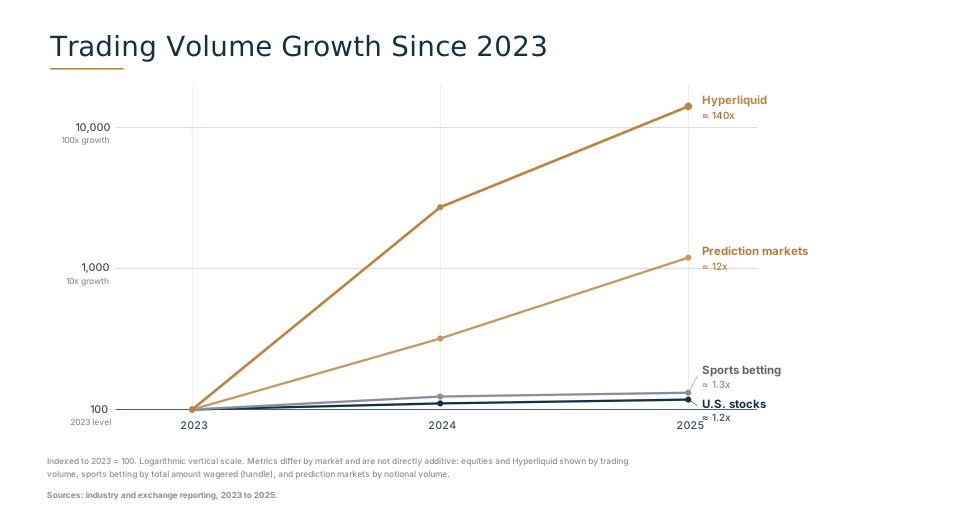
Why this matters: Trading volume across financial assets has expanded significantly, with the most notable rises in venues that emphasize accessibility, efficiency, and liquidity. Investors are increasingly desiring growth amidst backdrop of increasing money supply.
The Regulatory Green Light
None of this would be possible without a significant shift in the regulatory landscape, which is the part of the story that has changed most in the past year.
The clearest example is tokenization. The SEC is moving toward a framework for securities to trade in tokenized form, with tokenized shares trading alongside traditional shares at the same price and carrying the same rights. The infrastructure is moving quickly behind it, with the largest institutions in the country already running pilots.
America is, in a sense, about to have two stock markets for the same company. A traditional share and a tokenized share can represent the same ownership and trade at the same price, yet exist on entirely different rails, one settling through systems built decades ago, the other settling on a blockchain in seconds. The ambition is not small. BlackRock’s chief executive has said every stock and bond could eventually be tokenized, and the SEC has signaled it intends to go further still, with an exemption that would give platforms like Hyperliquid a formal path to operate as something close to a stock exchange.
Running through all of it is a push toward 24/7 trading. The market schedule, largely unchanged since the 1980s, is being dismantled, with regulators clearing the major exchanges to trade 23 hours a day. The rationale is partly global demand, but it is also competition. Crypto and prediction markets never close, and traditional exchanges do not want to cede the overnight hours. The temporal edges of the market are disappearing along with the categorical ones.
What This Means For A Portfolio
I want to be balanced here, because there is genuine opportunity in this shift alongside genuine risk. Tokenization is exciting on multiple fronts and could make markets faster, cheaper, and more accessible. Some of these venues are solving real problems, particularly the long-standing difficulty of investing in companies before they go public, as well as operational issues like waiting a day for trade settlement.
A few principles to keep in mind:
- Access is not the same as suitability. The fact that you can now trade almost anything does not mean all of it belongs in a portfolio. Each new venue should clear the same bar as any traditional investment.
- More liquidity and more hours can invite more activity. A market that never closes is a market that always offers a reason to act. The discipline of doing nothing becomes harder and more valuable when the market is always open.
- Distinguish investing from speculation. Some of these instruments are genuine investments. Others are closer to gambling dressed up as investing.
- New rails carry new risks. Tokenized assets introduce questions around custody, settlement, and what exactly you own. Announcements similar to Anthropic’s recent warning that voids “shares” sold on certain venues is the first of many.
The Bigger Picture
The financialization of everything is not a passing trend. It is the logical result of a large pool of capital meeting a financial industry highly skilled at creating new things for that capital to buy. The regulation now permits it, the technology enables it, and investor demand is pulling it forward.
For most investors, the right response is to recognize the shift for what it is and hold the same standards you always have. A tradable market in something is not the same as a good investment in it.
If anything, when everything becomes tradable, discipline becomes the only real edge left.
Enjoy your week,
Tyler